Evaluating Floral Pattern with Vintage Butterflies for Professional Design Projects
Selecting the right surface pattern is often the most critical decision in a creative project, particularly when balancing aesthetic appeal with technical requirements. A Floral Pattern with Vintage Butterflies occupies a specific niche within the broader category of botanical design, distinguished by its combination of nostalgic illustration styles and precise vector construction. Unlike generic floral repeats or modern minimalist botanicals, this specific style merges high-detail hand-drawn characteristics with the mathematical precision required for commercial production. For designers, event planners, and product developers aged 20 to 50, understanding the distinction between this asset class and standard raster alternatives is essential for avoiding costly reprint errors or licensing limitations.
Distinguishing Characteristics of High-Detail Vector Botanicals
The primary differentiator of a professionally crafted Floral Pattern with Vintage Butterflies is the underlying file architecture. While many vintage-style patterns available online are scanned images of antique textiles or watercolor paintings, true vector versions are mathematically defined paths. This distinction matters significantly when evaluating quality. Scanned vintage patterns often carry artifacts, uneven lighting, or pixelation that becomes apparent upon close inspection or resizing. In contrast, a carefully drawn vector interpretation retains crisp edges and consistent color values regardless of scale.
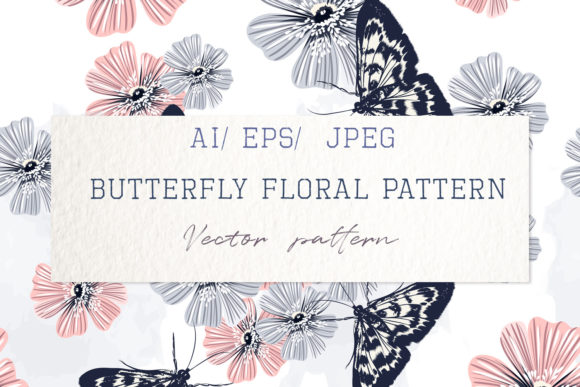
The "vintage" aspect in this context refers to the artistic lineage—often drawing from Victorian naturalism, Art Nouveau curves, or mid-century textile aesthetics—rather than the age of the file itself. The inclusion of butterflies adds a layer of complexity to the seamless repeat. Unlike static florals, lepidopteran elements introduce directional flow and asymmetry. A high-quality asset in this category will feature anatomically plausible butterfly illustrations integrated into the floral composition, rather than appearing as stamped overlays. This careful integration ensures the pattern reads as a cohesive surface design suitable for premium applications like wedding stationery or bespoke fabric printing.
Vector vs. Raster: Technical Tradeoffs and Production Fit
When comparing resources for floral design, the choice between vector (AI, EPS) and raster (JPEG, PNG, TIFF) formats dictates the end-use viability. A Floral Pattern with Vintage Butterflies provided in AI and EPS10 formats offers infinite scalability without degradation. This is non-negotiable for large-format applications such as wallpaper murals, stage backdrops, or trade show signage. If a designer attempts to upscale a 5000px JPEG preview to cover a 10-foot wall, the result will inevitably be soft or pixelated. Vector files eliminate this risk entirely.
However, vectors come with their own set of tradeoffs. Complex floral patterns with high node counts can be computationally intensive. Opening a detailed seamless pattern in Adobe Illustrator may require significant RAM, especially if the design contains hundreds of individual anchor points per repeat. Raster files, conversely, are lightweight and universally compatible but lack editability. If your workflow requires changing the background color from cream to blush, or isolating a single butterfly motif for a logo, only the vector version provides this flexibility. The 5000x5000 px JPEG preview included with these assets serves best as a proofing tool or for digital-only mockups, not as a final production master for print.
Evaluating Seamless Repeat Integrity
Not all seamless patterns are created equal. When researching options, it is vital to verify how the Floral Pattern with Vintage Butterflies handles edge transitions. Poorly constructed seamless designs often exhibit visible grid lines or awkward cropping where motifs intersect the tile boundary. High-quality vector patterns utilize precise bounding boxes and mirrored elements to ensure continuity. Before committing to an asset for fabric manufacturing or wallpaper installation, users should test the repeat at various scales. The advantage of the EPS10 format is that it preserves this tiling logic across virtually all vector-compatible software, ensuring the seamlessness remains intact during editing.
Comparative Analysis: Vintage Vector vs. Alternative Styles
Designers frequently weigh vintage botanical vectors against other popular categories. Understanding where Floral Pattern with Vintage Butterflies fits relative to these alternatives helps clarify its best-fit scenarios.
- Versus Modern Minimalist Florals: Minimalist designs rely on negative space and simplified shapes. They are excellent for contemporary branding and small-scale web graphics but can feel sterile in traditional contexts. Vintage butterfly patterns offer higher visual density and emotional resonance, making them superior for heritage brands, weddings, and artisanal packaging where warmth and craftsmanship are key selling points.
- Versus Photographic Botanicals: Photography captures reality; vector art captures essence. While photographic floral patterns provide realism, they are difficult to recolor and often clash with typography due to complex value ranges. Vector vintage patterns typically use flattened colors or controlled gradients, providing better contrast for overlaid text and easier adaptation to specific brand palettes.
- Versus AI-Generated Patterns: Generative AI has flooded the market with floral imagery. However, AI outputs are inherently raster-based and often contain anatomical errors in butterfly wings or nonsensical flower structures. Hand-drawn vector assets guarantee anatomical accuracy and clean topology. For professional clients who scrutinize detail, the intentionality of a human-drawn vector file remains the industry standard.
Practical Applications and Material Considerations
The versatility of a Floral Pattern with Vintage Butterflies extends across multiple mediums, but material choice influences which file version to prioritize. For wedding decorations, such as laser-cut invitations or acrylic table numbers, the vector paths serve directly as cut lines. The intricate details of vintage butterflies translate exceptionally well to engraving and foil stamping, where line clarity determines production success.
In textile design, the considerations shift. Fabric printing technologies like rotary screen printing or digital sublimation handle vector data differently. While the source file is vector, the printer’s RIP software will eventually rasterize it at a specific DPI. Having access to the original AI file allows designers to adjust stroke weights before output. Thin lines that look elegant on screen may disappear on uncoated paper or bleed excessively on raw linen. The ability to globally adjust stroke width in a vector environment is a critical safety net that raster-only users do not possess.
For digital applications like website backgrounds or social media templates, the 5000x5000 px JPEG preview is often sufficient. It provides high resolution for retina displays without the overhead of rendering complex vectors in real-time. However, if the digital project involves responsive design where the pattern must stretch dynamically, SVG exports derived from the AI/EPS source will yield sharper results than any fixed-size image.
Decision Factors: When to Choose This Asset Type
Determining whether a Floral Pattern with Vintage Butterflies is the correct resource requires honest assessment of project constraints. This asset type is the optimal choice when:
- Editability is Required: You need to extract individual elements, modify colors, or resize motifs independently.
- Scale Variance is Expected: The same design will be used for a business card and a banner, requiring lossless scaling.
- Traditional Aesthetics are Mandated: The project brief specifies nostalgia, romance, or organic intricacy that geometric or abstract patterns cannot convey.
- Production Standards are High: Commercial printing or manufacturing demands clean paths and defined color separations.
Conversely, readers should consider alternative options if:
- File Size is a Hard Constraint: Web performance is the primary metric, and even optimized SVGs are too heavy compared to compressed WebP textures.
- Photorealism is Essential: The client specifically requests photographic texture or natural light effects that vector art cannot authentically replicate.
- Budget Prohibits Licensing: Premium hand-drawn vector assets typically command higher prices than mass-market raster packs. If the usage is personal or low-stakes, a simpler alternative may suffice.
- Software Compatibility is Limited: Users without access to Adobe Illustrator or CorelDRAW may struggle to utilize AI/EPS files effectively, making pre-rasterized alternatives more practical despite their limitations.
Technical Specifications and Workflow Integration
When acquiring a Floral Pattern with Vintage Butterflies, verifying the technical deliverables ensures smooth integration into existing workflows. The inclusion of an AiCS2 file indicates backward compatibility, allowing users with older versions of Creative Suite to open the artwork. The EPS10 file acts as the universal exchange format, compatible with Affinity Designer, CorelDRAW, and Inkscape, though some advanced gradient meshes or transparency effects may flatten depending on the software. Always test the EPS in your specific application before beginning production work.
The 5000x5000 px JPEG preview serves a dual purpose: immediate visualization and color reference. Because vector rendering can vary slightly between applications, the JPEG represents the artist’s intended color balance and composition. Use this raster reference to calibrate your vector workspace. Additionally, for users creating composite designs, the high-resolution preview can function as a temporary placeholder in layout software like InDesign or QuarkXPress, keeping document sizes manageable until final export.
Ultimately, the value of this asset lies in its hybrid nature. It delivers the emotional warmth of vintage illustration with the rigorous utility of modern vector engineering. By understanding the technical distinctions, comparative advantages, and practical limitations outlined above, professionals can confidently determine if this specific pattern style aligns with their project’s aesthetic goals and production realities. Whether for bespoke wedding stationery, commercial textile development, or digital branding, informed selection prevents downstream issues and ensures the final output honors the intricate beauty of the original design.